

The Problem With Predicting the Mean
Suppose you want to predict tomorrow’s return using today’s information. We collect some features (X_t) and fit a regression model:
This seems reasonable at first. If our model predicts a return of 0.5%, we can use that prediction to decide whether to trade, how much to trade, or which assets to prefer.
But there is a fundamental problem with this approach:
It condenses all information into a single number.
Distributions can look vastly different while having the same mean.
Here are 6 distributions, all with a mean of 0.5%:
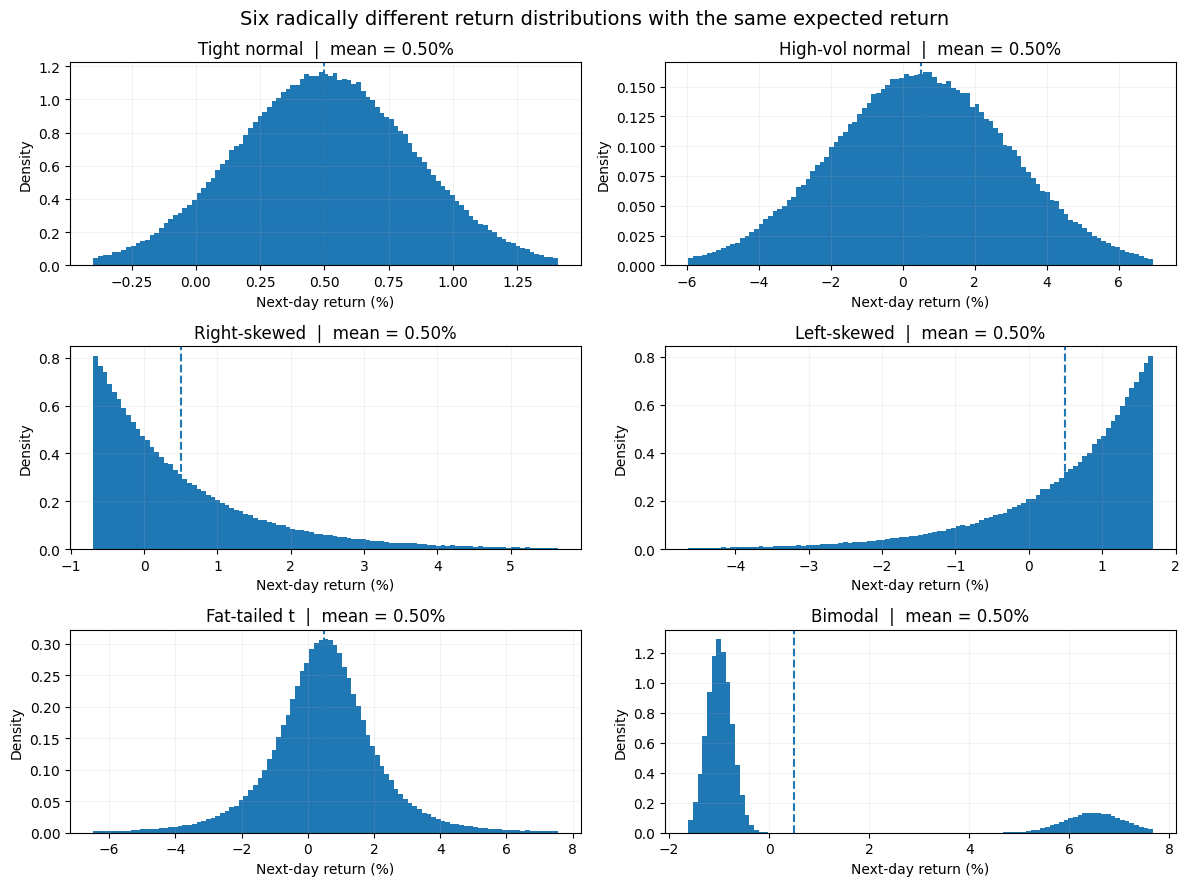
Consider only the tight normal and high-vol normal. We would always wish for the tight normal, since we are way more confident about our predicted return.
Now you could go and layer on top something like conformal prediction (which we discussed in our previous article) to get a sense of uncertainty, but even that doesn’t tell you the whole distribution.
And here is another idea: If you are able to predict the entire distribution, you can back out numbers like:
The probability of the trade being profitable.
The probability of a loss of a certain size.
Any arbitrary quantity of the distribution.
This is what Distributional Regression gives you.
I write about quantitative trading the way it’s actually practised:
Robust models and portfolios, combining signals and strategies, understanding the assumptions behind your models.
Topics I write about include portfolio construction, market making, risk management, research methodology, and more.
If this way of thinking resonates, you’ll probably like what I publish.
What you’ll learn
Why predicting the conditional mean throws away most of the information contained in a return distribution.
How distributional regression turns a conventional regression problem into one of predicting the entire conditional probability distribution.
How link functions map unconstrained predictors to valid distributional parameters, allowing us to model quantities such as scale or tail parameters while respecting their constraints.
How NGBoost combines gradient boosting with probabilistic prediction to learn these distributional parameters.
How distributional predictions can give you quantities such as volatility, quantiles, tail probabilities, and expected shortfall from a single model.