


A lot of you have requested that I start covering topics on options and specifically volatility so here we go! This will be the first of many posts that cover those topics so consider getting a subscription to not miss out on them:
https://www.vertoxquant.com/62375e34
Volatility Arbitrage is probably the most well known volatility strategy so that’s what we’ll be starting with. It’s also very misunderstood as it’s NOT just trading the difference between implied and realized volatility.
Table of Content
What Volatility Arbitrage ACTUALLY is
Measuring Realized Volatility
Forecasting Realized Volatility
Black-Scholes Model
Solving for IV
IV Dynamics and the IV Surface
RV Forecast vs IV
Hedging
Volatility Arbitrage in Practice
Concerns
Final Remarks
What volatility arbitrage ACTUALLY is
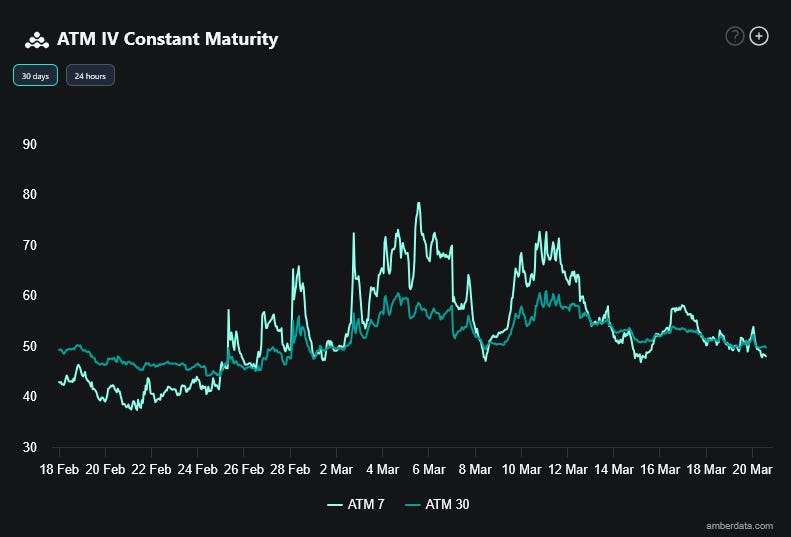
Most sources state that you are trading the difference between implied volatility and realized volatility but that’s not exactly true.
Implied volatility is something that we see in the Black-Scholes model (which we will talk about in more detail in one of the next sections) and it *can* be interpreted as the expected future volatility with the assumptions of the Black-Scholes model but in reality its just an interpretation of option price.
In reality supply & demand determine the price and price movement of an option. Price didn’t move because the options greeks said that price will increase with an increase in IV but because of supply & demand. We *can* however try to explain some of those supply & demand dynamics via option greeks which is their purpose.
So rather than being truths the greeks are rather predictions of what we think prices will behave like for changes in variables like implied volatility (vega) or time (theta).
Let’s say you bought an OTM call and volatility (or rather what the market *thinks* volatility will be) increases. You now have a higher probability of moving ITM and making a profit so your option price should increase (Vega bigger than 0).
Let’s now say you know that markets will become more volatile but the other market participants don’t. Then you would buy the call because it’s underpriced and you expect that other market participants will realize that markets will become more volatile soon (or once that volatility hits) which we predict will cause IV to increase which we then predict would increase the options price.
Besides expected volatility there are a bunch of other factors affecting our trade as well. The passage of time will affect the price of the option we are trading (theta), liquidity of the option will, etc.
So to summarize: We aren’t trading the difference between expected and realized volatility, we aren’t even just trading the change in expected future volatility. It is one factor that affects the option price.
The statement that we are “trading the difference between implied volatility and realized volatility” isn’t entirely untrue though. Whenever there is a big difference in implied volatility and predicted volatility that can indicate that there is some mispricing in the option because the market has a wrong view on what future volatility will be (Or becaue you don’t know what the market knows which is probably more likely).
One reason why this descepancy appears can be explained as a risk premium. Long options have limited downside while short options have unlimited downside and we want to get compensated for this risk which is why options tend to be overpriced which in turn leads to higher IVs so it looks like the market is overestimating volatility.
So you should stop looking at IV as purely the markets expected future volatility but as a variable that is heavily correlated to future expected volatility but has other factors that affect it too.
As you can now see volatility arbitrage is, unlike its name implies, not an actual arbitrage but a statistical arbitrage (I really don’t like the term statistical arbitrage, why is it called an arbitrage if its not?).
Measuring Realized Volatility
Okay so we’ve been talking about volatility but what actually *is* volatility?
There are different ways to measure and define volatility. We can broadly define it as how much and how strongly price moves.
That definition is ambiguous though. We could be looking at the price range over some period, the standard deviation of returns and many more. Let’s look at a few definitions of volatility: